MusicArmonia
An interactive laboratory for exploring scales, modes, Neo-Riemannian Tonnetz spaces, and chord progressions. Built natively for macOS.
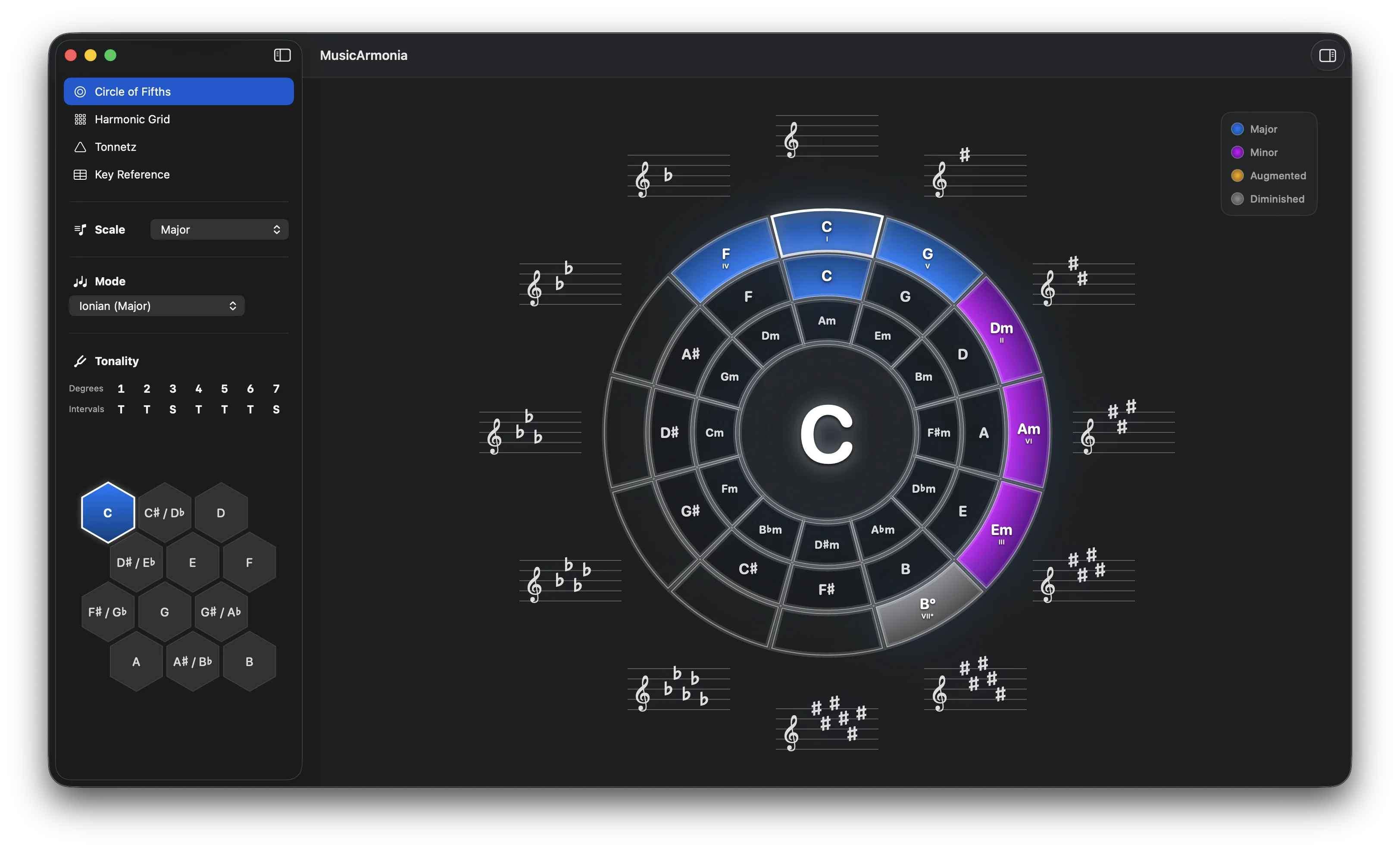
An interactive laboratory for exploring scales, modes, Neo-Riemannian Tonnetz spaces, and chord progressions. Built natively for macOS.
MusicArmonia bridges the gap between music theory and creative composition. Explore key relationships, chord voicing grids, Neo-Riemannian networks, and transpositions in a unified, modern interface.
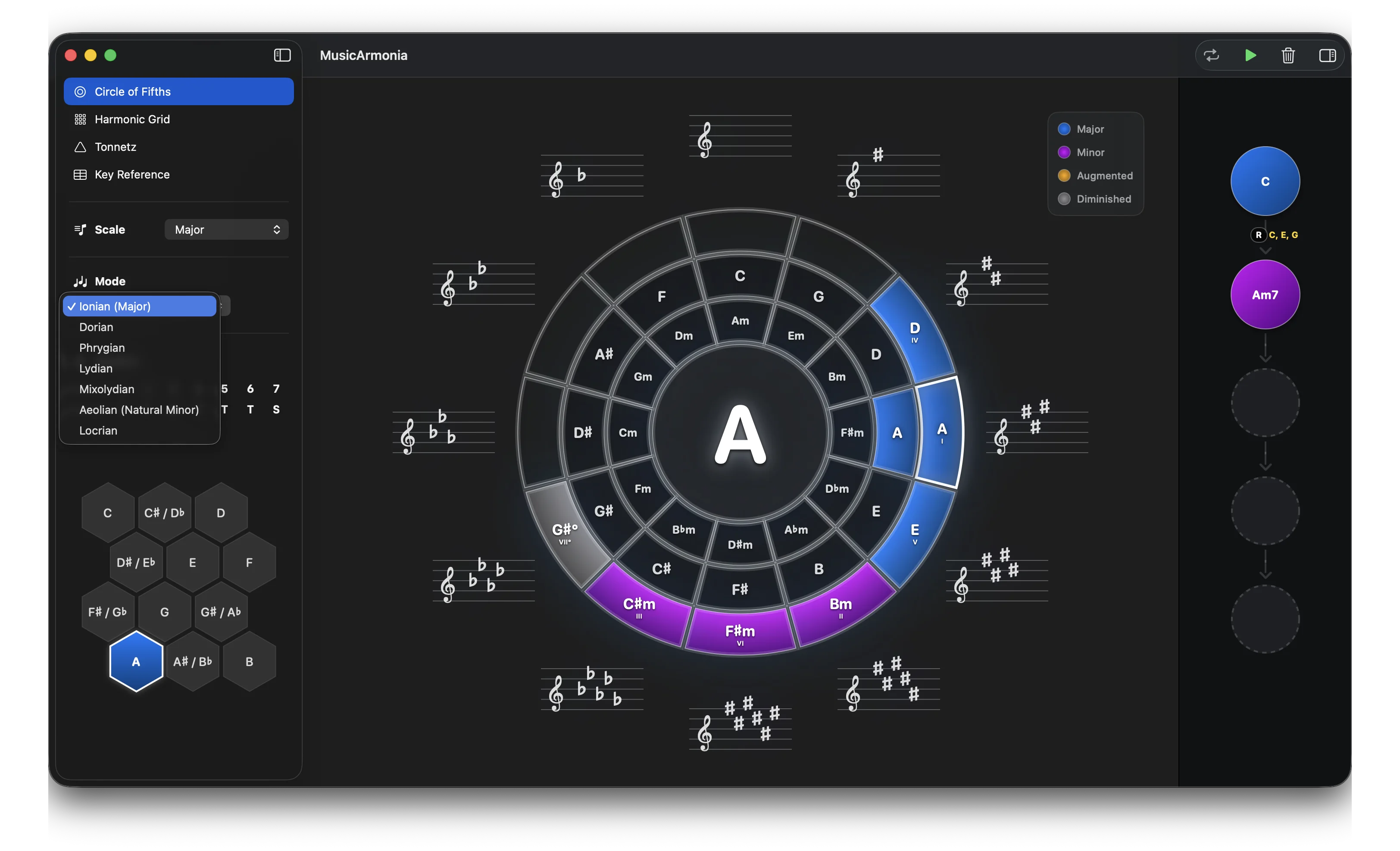
Explore major/minor key signatures, relative scales, and diatonic functions in 4 concentric rings with high-fidelity treble staff rendering.
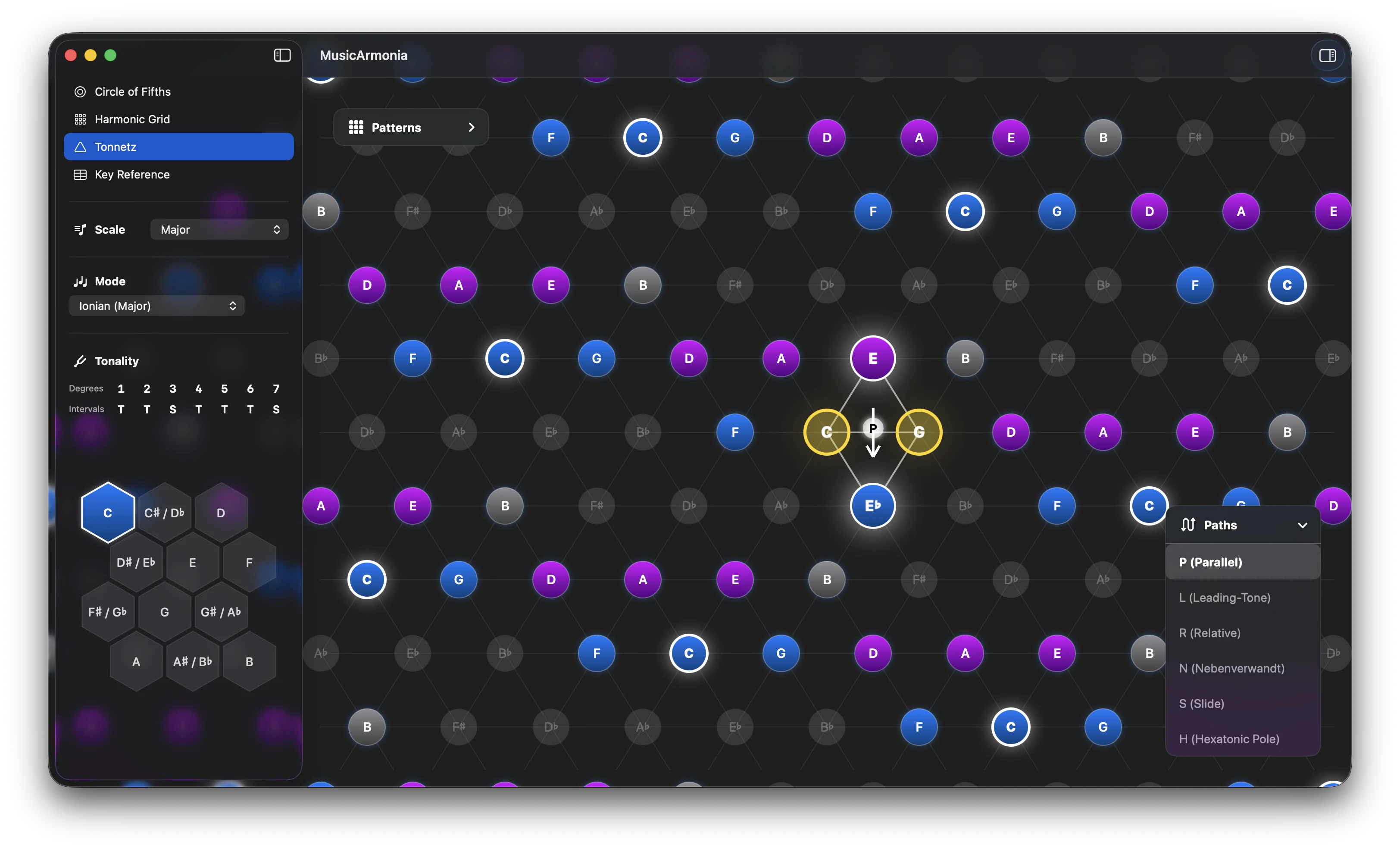
Visualize triads as triangles on a slanted lattice. Study voice-leading transformations (P, L, R) and see how notes pivot and slide.
Browse diatonic chords grouped by scale degree and harmonic function. Analyze progressions in a clear functional layout.
Build, analyze, and transpose custom chords using Nashville Numbers and Roman Numeral analysis, then save them into your track.
Play, sequence, and loop saved chords natively. Listen to progressions with high-quality playback to hear how your changes sound.
Built with SwiftUI, Core Graphics, and Metal. Highly responsive, optimized for Apple Silicon, and operates completely offline.
Visualizing Keys, Relative Modes, and Signatures
The Circle of Fifths arranges the 12 chromatic pitches in a sequence of perfect fifths (7 semitones). Keys sharing adjacent positions are closely related: they share all but one accidental in their scales. This circular geometry shows how close major and minor keys are, and makes transpositions and modal modulation patterns visually evident.
MusicArmonia represents this theory through 4 concentric glassmorphic rings:
Mapping Triads, Transformations, and Voice Leading
Pioneered by Leonhard Euler and popularized by Hugo Riemann, the Tonnetz (tone-network) is a slanted grid representing pitch space. Notes are connected along three geometric axes of consonant intervals:
MusicArmonia models this hexagonal slanted grid dynamically. Hovering over a transformation (like L-P-R paths) displays the visual movement of the triad triangle flipping across its edges. Common notes glow, showing you how voices transition smoothly from one chord to another on the lattice.
Nashville Numbers, Roman Numerals, and Chord Spelling
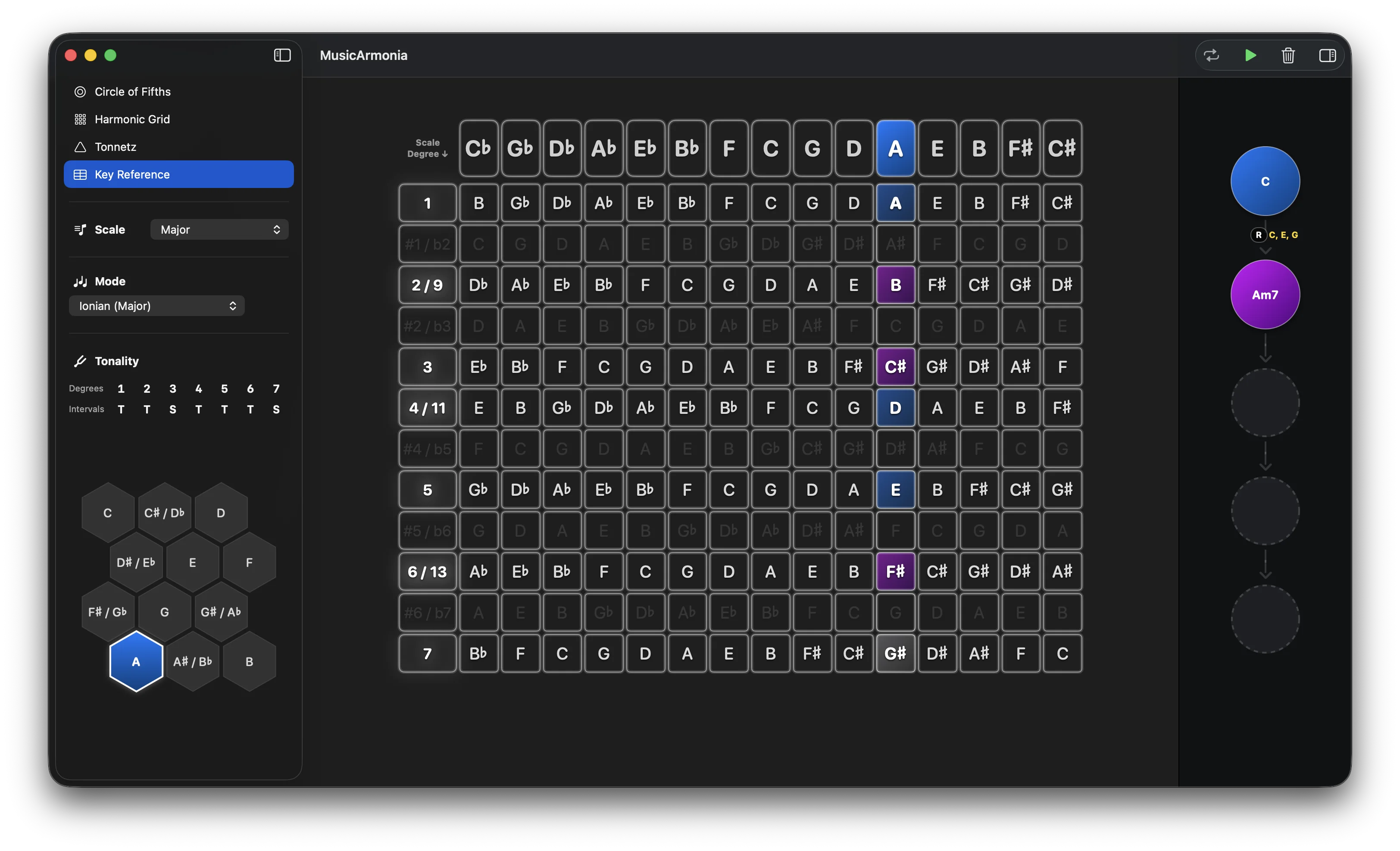
The Nashville Number System and Roman Numeral Analysis abstract chord progressions from absolute pitches to relative scale degrees (e.g. I, IV, V, vi). This allows you to easily analyze harmonic relationships and transpose progressions instantly into any key.
The Key Reference view is a grid of 15 key columns and 12 scale degrees. It highlights diatonic intervals and notes. By tapping cells in this matrix, you can build custom chord spellings. The built-in Harmony Analyzer identifies the chord name (e.g. Cmaj7, Am9) and lets you save it to your sequence. You can then transpose your entire progression by clicking different key columns at the top, transposing your saved chords instantly.
MusicArmonia is a native Mac app built with SwiftUI. macOS 14 Sonoma is the minimum supported version.
Designed for M1, M2, M3, and M4 series chips. Runs natively on macOS with low CPU footprint and smooth rendering.
No internet connection required. Your configurations, saved progressions, and selections are stored locally on your device.
MusicArmonia does not collect any data. No analytics, no crash reporting, no user accounts. Everything happens locally on your Mac.
Read the full Privacy PolicyNeed help getting started or want to learn more about the harmonic theory behind the app?
Open the User Guide